
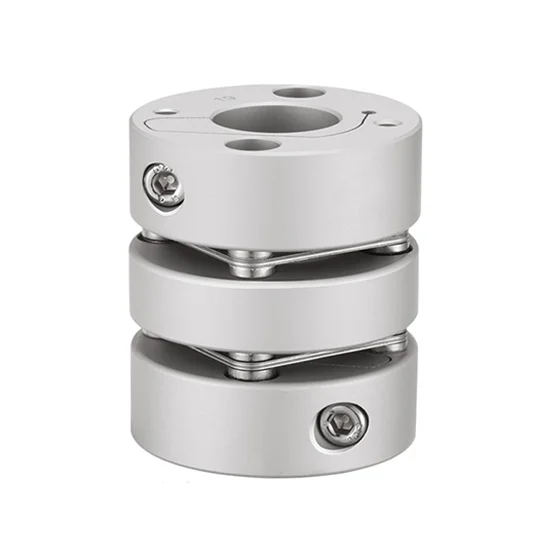
Description
Dual diaphragm coupling diameter 56mm, length 64mm, bore 12mm to 25mm, speed 10000rpm, shaft and sleeve connection without clearance, suitable for forward and reverse rotation.
Specification
| Model | ATO-SC-GLM5664 |
| Length | 64mm |
| Width | 56mm |
| Bore | 12mm to 25mm |
| Rated Torque | 25 N.m |
| Allow Eccentricity | 0.27mm |
| Allowable Deflection Angle | 1.5∠° |
| Allowable Axial Deviation | ±0.72 |
| Allowable Speed | 10000 RPM |
| Static Torsional Stiffness | 9000N.m/rad |
| Moment of Inertia | 1.6 x 10⁻⁴ |
| Weight | 320g |
| Certificate | ISO9001, REACH, RoHS |
| Warranty | 12 Months |
Bore 12mm to 25mm Diaphragm Coupling Dimension (unit: mm)
| d1/d2 Inner Diameter Size | Φd | L | LF | LP | S | φd3 | F | M | Tightening Torque |
| 10-11-12-12.7-14-15-16-17-18-19-20-22-25 | 56 | 64 | 19.75 | 13.5 | 5.5 | 26 | 8 | M5 | 8 N.m |
Details
Keyway
| Shaft Diameter | Keyway Standard Machining Dimensions | Keyway Size | |||
| d1/d2 | b | t | (bXh) | ||
| Width of groove | Tolerance | Depth of groove | Tolerance | ||
| φ6~φ7.9 | 2 | ±0.0125 | 1 | ±0.10 | 2×2 |
| φ8~φ10 | 3 | 1.4 | 3×3 | ||
| φ10.1~φ12 | 4 | ±0.0150 | 1.8 | 4×4 | |
| φ12.1~φ17 | 5 | 2.3 | 5×5 | ||
| φ17.1~φ22 | 6 | 2.8 | 6×6 | ||
| φ22.1~φ30 | 8 | ±0.0180 | 3.3 | ±0.20 | 8×7 |
| φ30.1~φ38 | 10 | 3.3 | 10×8 | ||
| φ38.1~φ44 | 12 | ±0.0215 | 3.3 | 12×8 | |
| φ44.1~φ50 | 14 | 3.8 | 14×9 | ||
| φ50.1~Ф58 | 16 | 4.3 | 16×10 | ||
| φ58.1~φ65 | 18 | 4.4 | 18×11 |
Keyway Machining Standard Drawing
Tips: What causes abnormal noise in the diaphragm coupling?
- The gap between the two halves of the coupling is too wide, causing the diaphragm to receive a large axial force, and the stranded hole or stranded bolt is worn out, causing abnormal noise.
- Excessive axial offset or too large deflection angle of the two halves of the coupling will also cause vibration and abnormal noise during equipment operation.
- When the speed of the active end and the passive end are different, it will also cause vibration and abnormal noise during the operation of the equipment.
- The speed code disc of the motor is faulty, which causes the speed of the motor to be fast and slow, and the diaphragm coupling makes abnormal noise.
Reviews
There are no reviews yet.