
Description
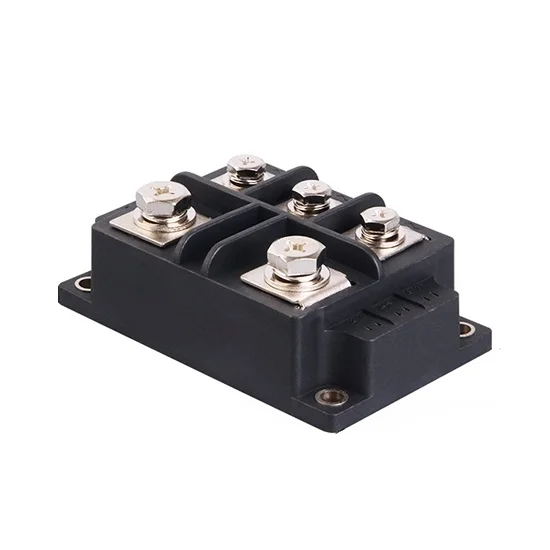
High-power bridge rectifier module plays a key role in multiple applications: providing stable DC power to instruments and equipment, converting input power to PWM frequency converters, providing high current DC power to inverter welding machines, and so on.
Features
- Provide electrical insulation of 2500V voltage between the chip and the substrate to ensure reliable isolation.
- 3-phase bridge rectifier module has excellent temperature characteristics and power cycling capability, and can operate stably under extreme working conditions.
- Its design achieves low forward voltage drop, thereby improving energy efficiency and reducing power loss.
- The bridge rectifier module supports high surge currents to meet the demand for instantaneous high loads.
- The maximum working junction temperature of the equipment can reach 150 ℃, meeting the requirements of high-temperature environments.
- Its compact design makes it small in size and lightweight, making it easy to install and move.
Specification
| Model | ATO-LJ-MDS300A | ATO-LJ-MDS400A |
| DC output current | 300A | 400A |
| Reverse repetitive peak voltage | 1600V | |
| Reverse repetitive peak current | 5mA | |
| Forward non repetitive surge current | 3.6KA | |
| Square time product of surge current | 50A2s*103 | |
| Threshold voltage | 0.8V | |
| Slope resistance | 3.5mΩ | |
| Positive peak voltage | 1.30V | |
| Thermal impedance (junction to shell) | 0.14℃/W | |
| Thermal impedance (shell to radiator) | 0.07℃/W | |
| Insulation voltage | 2500V | |
| Installation torque (M6) | 6N·m | |
| Installation torque (M8) | 10N·m | |
| Storage temperature | -40~125℃ | |
| Weight | 620g |
Note: This product must be installed on a heat sink. Please contact us to choose a suitable heat sink according to the actual situation.
Dimension (mm)
Circuit Diagram
Tips: How to choose a bridge rectifier module?
- Choose a module with a maximum current rating that meets or exceeds the peak current requirements of your application.
- Ensure the module’s maximum voltage rating is higher than the operating voltage of your system to prevent potential damage.
- Select a module with sufficient heat dissipation features or a compatible heat sink to avoid overheating during operation.
- Pick a package type, such as surface-mount (SMD) or through-hole, that fits your installation and spatial constraints.
- Consider the module’s ability to operate in your specific environmental conditions, including temperature and humidity.
Reviews
There are no reviews yet.