
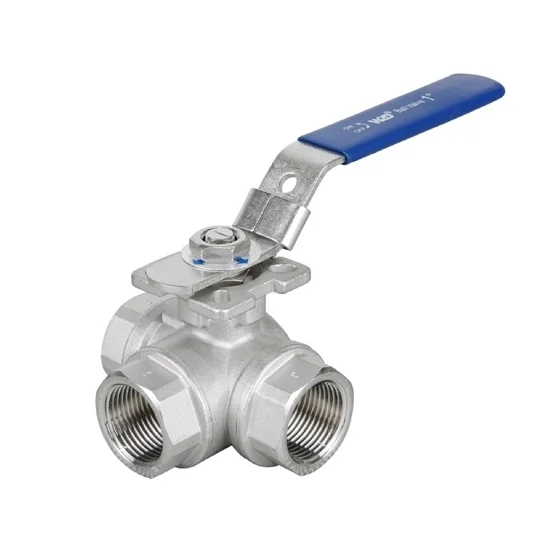
Description
Note: This ball valve cannot be used for drinking water.
Low cost 2 inch (DN50) stainless steel 3 way ball valve is provided with 1000PSI working pressure, L port and T port, BSP/BSPT/NPT thread standard, SS 304/316 material, can be used in heating, ventilation and air conditioning (HVAC) system to regulate the cooling flow of hot water and air.
Specifications
- Model: ATO-Q14/15F-63/1000WOG(C/P/R)
- Size: 2 inch (50mm)
- Connection Method: Thread
- Threaded Ends: BSP, BSPT, NPT
- Port: T Port/L Port
- Mounting Pad: ISO5211
- Working Pressure: 1.6MPa
- Temperature Range: -20℃~180℃
- Weight: About 4.505kg (T), 4.585kg (L)
- Material: 304/316 Stainless Steel
Dimension (Unit: mm)
| DN | D | L±1.5 | L1 | H | T | C | NM | ISO5211 |
| 50 | 38 | 150 | 119 | 121 | 193 | 14 | 24 | F05/F07 |
Main Part Materials
| NO. | PART NAME | MATERIAL | QTY |
| 1 | CAP | CF8/CF8M | 3 |
| 2 | SEAT | PTFE/RPTFE | 4 |
| 3 | JOINT GASKET | PTFE/RPTFE | 3 |
| 4 | THRUST WASHER | PTFE/RPTFE | 1 |
| 5 | PACKING | PTFE/RPTFE | 1 |
| 6 | STEM | S304/S316 | 1 |
| 7 | GLAND | SS304 | 1 |
| 8 | NUT | SS304 | 2 |
| 9 | BALL | S304/S316 | 1 |
| 10 | BODY | CF8/CF8M | 1 |
| 11 | HANDLE | S304 | 1 |
| 12 | HANDLE COVER | PVC | 1 |
| 13 | LOCK | SS304 | 1 |
Applications
3-way ball valves are used in a wide range of industries, including oil and gas, chemical processing, HVAC, and water treatment. They are suitable for applications where precise control of fluid or gas flow is required, and where the ability to divert or mix the flow is important.
Tips: How to maintain a 3 way ball valve?
- Regular inspection: Inspect the valve regularly for any signs of wear or damage, such as leaks, corrosion, or cracks. This will help to identify any potential issues before they become major problems.
- Lubrication: The ball and stem of the valve should be properly lubricated to ensure smooth operation. Apply a high-quality lubricant regularly to prevent friction and reduce wear on the valve components.
- Cleaning: Clean the valve regularly to remove any dirt, debris, or other contaminants that may affect its operation. Use a soft-bristled brush or a clean cloth to clean the valve components, and avoid using abrasive materials that may scratch or damage the valve.
- Pressure testing: Periodic pressure testing of the valve can help to identify any leaks or other issues that may affect its performance. Perform pressure testing at regular intervals as recommended by the manufacturer.
- Replacement of worn parts: If any part of the valve is worn or damaged, replace it immediately. This will help to prevent further damage to the valve and ensure its continued operation.
- Proper installation: Ensure that the valve is installed correctly, with the proper alignment and torque specifications. Improper installation can cause damage to the valve and affect its performance.
Reviews
There are no reviews yet.