
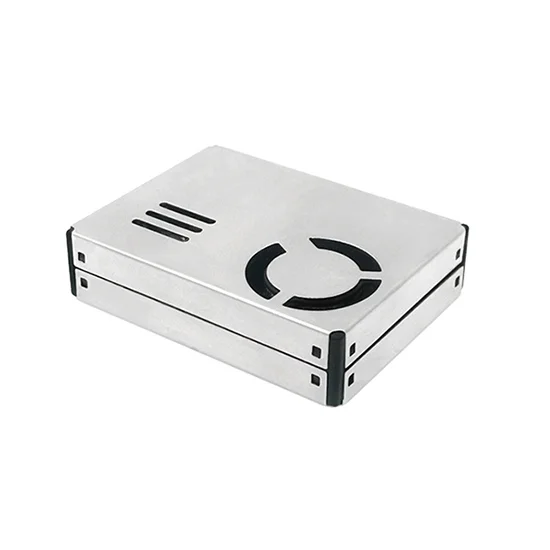
Description
The PM2.5 air quality sensor uses laser light scattering technology with a measurement range of 0.3–10 µm and has a particle concentration range from 0 to 700 µg/m3. It supports fast real-time data feedback with a response time of 1–10 seconds, ensuring real-time monitoring of air quality.
Specification
| Model | ATO-D7 |
| Measurement Range | 0.3–10 μm |
| Effective Mass Concentration Range | 0–700 μg/m3 |
| Maximum Mass Concentration Range | ≥1000 μg/m3 |
| Mass Concentration Resolution | 1 μg/m3 |
| Effective Sampling Volume | 0.1 L |
| Particle Count Range | 0–65535 particles/0.1 L |
| DC Supply Voltage | 4.9–5.1 V |
| Interface Logic Level | 2.7–3.6 V |
| Maximum Operating Current | 70 mA |
| Response Time | 0–10 s |
| Operating Temperature | -10–60 ℃ |
| Storage Temperature | -30–80 ℃ |
| Operating Humidity (Non-condensing) | 5%–80% RH |
| Storage Humidity (Non-condensing) | 0%–95% RH |
| Particle Mass Concentration Accuracy (0–100 μg/m³) | ±10 μg/m3 |
| Particle Mass Concentration Accuracy (≥100 μg/m³) | ±10% |
| Weight | 55 g |
Size (unit: mm)
Air Quality Instructions
- Coal pollution and tailpipe pollution can harm the respiratory system.
- High levels of particulate matter pollution in large and medium-sized cities can lead to acidic rainfall.
- The impact of new urban development on air quality is emphasizing the “greenhouse effect”.
Wiring Instructions
| PIN | Signal Name | Description |
| PIN1 | VCC | Power positive 5V |
| PIN2 | VCC | Power positive 5V |
| PIN3 | GND | Power negative |
| PIN4 | GND | Power negative |
| PIN5 | NC | – |
| PIN6 | PWM | PWM pulse width signal output pin (3.3 V logic level) |
| PIN7 | RXD | UART RX pin (3.3V logic level) |
| PIN8 | Reservations (NC) | No connection |
| PIN9 | TXD | UART TX pin (3.3V logic level) |
| PIN10 | SET | Low level: POWERDOWN; high level or floating: normal operation |
Applications
Tips: What should be considered during installing the laser PM2.5 air quality sensor?
- Ensure that the laser PM2.5 air quality sensor is installed in a location with stable and unobstructed airflow. The air inlet and outlet of the sensing chamber must remain clear, as any blockage may affect sampling efficiency and measurement accuracy.
- Avoid placing the laser particulate matter sensor in environments with heavy dust, oil mist, water vapor, or condensation, as these conditions may contaminate the optical chamber and interfere with laser scattering detection.
- Do not install in areas exposed to corrosive gases or chemical vapors, which may damage internal optical components and reduce long-term reliability.
- It is recommended to keep the air quality sensor away from heat sources and high-humidity zones, ensuring a stable operating environment for consistent performance.
- For optimal accuracy, install in a well-ventilated, clean airflow channel with minimal turbulence or sudden pressure changes.
Reviews
There are no reviews yet.