
Description
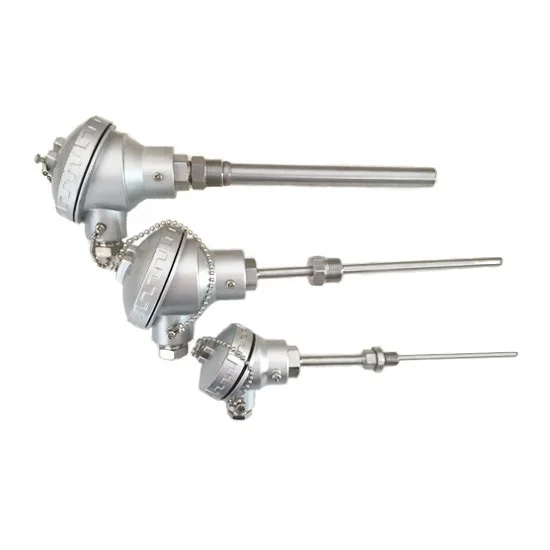
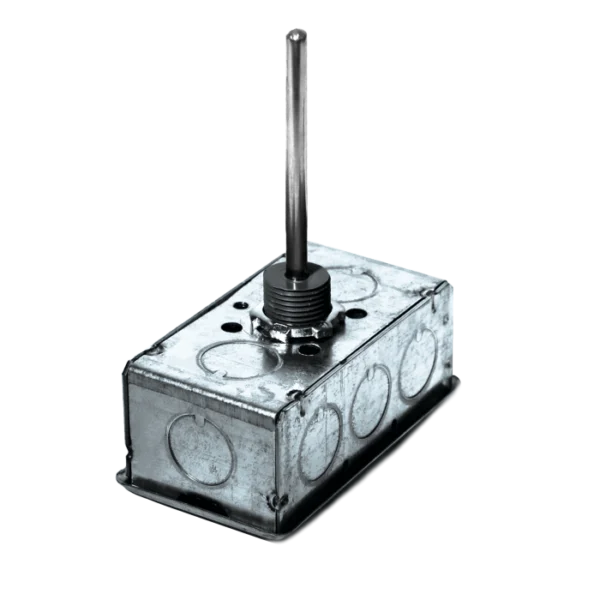
RTD (resistance temperature detector) sensor can directly connect to secondary instrument by copper conductor, and provide accurate input signal of temperature changes for display instruments, recording instruments, signal conditioners, scanister and computer.
Specification
1. RTD temperature range and accuracy chart
| Type of sensing element | Measuring range | Allowable deviation Δt |
| Pt100 | -200~420℃ | Class B (-200~800℃) Permissible deviation ±(0.30+0.005|t|) |
| Class A (-200~650℃) Permissible deviation ±(0.15+0.002|t|) |
Note: t is the actual measuring temperature absolute value of the temperature sensing element.
2. Thermal response time of RTD sensor
| Sheath diameter (mm) | Thermal response time (s) |
| Ф3 | ≤3 |
| Ф4 | ≤5 |
| Ф5 | ≤8 |
| Ф6 | ≤12 |
| Ф8 | ≤22 |
Feature
- High Precision: RTD sensor uses excellent temperature measuring elements, so it has the advantages of accuracy, sensitivity, fast thermal response time, stable quality and long service life.
- Corrosion Resistance: The outer protective sleeve is made of stainless steel and filled with high-density oxide insulators, so it has strong anti-pollution performance and excellent mechanical strength, suitable for installation in harsh environments.
- Good Performance: Pt100 RTD sensor can be used to measure temperatures in the range of -200℃~+420℃, and can be directly connected to secondary instruments with copper wires. Because it has good electrical output characteristics, it can provide accurate temperature change input signals for displays, recorders, regulators, scanners, data recorders and computers.
Installation
| Installing standard size | Sheath diameter | |||||
| Ф8 | Ф6 | Ф5 | (Ф4) | Ф4 | Ф3 | Ф2 |
| M | M16*1.5 | M12*1.5 | ||||
| S | 22 | 19 | ||||
| D | Ф60 | Ф50 | ||||
| D0 | Ф42 | Ф36 | ||||
| D1 | Ф24 | Ф20 | ||||
| d0 | Ф9 | Ф7 | ||||
| S | 22 | 19 |
Connection Mode
Selection
| Branch number | Installing form | Mode of connection | Sheath diameter | Sheath length |
| B1: Single branch; B2: Double branch |
I1: No fixed device; I2: Fixed card sets of thread joint; I3: Movable card sets of thread joint; I4: Fixed card sets of flange; I5: Movable card sets of flange |
C0: Simple terminals; C3: Standard waterproof protection head; C4: Explosion-proof protection head; C6: Aviation plug; C9: Direct lead 3 wire |
D3: Φ3; D4: Φ4; D5: Φ5; D6: Φ6; D8: Φ8 |
Single branch: 100~1000mm; Double branch: 100~500mm |
Application
Tips: Differences between sheath RTD sensor and general thermal resistance
The sheath RTD sensor is the thermal resistance that is soldered and sealed thermistor temperature-sensing element in the sheath wire, which consists of metal casing pipe, insulation material and metal wires. The metal casing material of sheath wire is usually stainless steel. The lead wire is usually copper conductor or silver conductor, and the insulation material is usually magnesium oxide.
There are many characteristics of sheath RTD sensor compared with the general thermal resistance.
- The external diameter of thermistor can be small, so its time constant is small and reaction speed is fast.
- It has bendability and is suitable for temperature measurement of complex structure and small equipment.
- It has good vibration resistance and impact resistance.
- It has long service life.
Reviews
There are no reviews yet.